‘Oh, Jesus! His eye is gone, so it is!’ The hospital cleaning lady stared out over the counter at me.
It was Cork city, mid-sixties, and I had just been ferried into the hospital after an encounter with a heavy wooden swing in a Cork park. A12-yr old, I was on my way with my 6th class group to the Gaeltacht in Ballingeary. The train down had been fun. 12-year-old card sharps playing for pennies and cigarettes sucked slyly in toilets. I had been shipped up to the Donegal Gaeltacht a few years early after returning from a few years in London. We had crossed the border in the lee of the IRA Border Campaign (Operation Harvest 1956-1962). RUC men in bottle green uniforms with sterling sub machine guns boarded the bus at one stage. It was all very Celtic Cold War. I was sent over to Connemara a year or two later, which was a different world from Cork and Donegal again. The truth was, my heart was more in Cork thatn in the West or North, not that I had anything against those compass points. There was just something warm and laid back about Cork.
There still is.
Living only a train hour from Dublin and a train hour and a half from Cork, I get to see Cork three or four times a year, for no particular reason. My flȃneur routine is pretty much the same: wandering around the city aimlessly, a little light shopping in the English market, lunch, an afternoon pint in one of the cosy pubs, and the train back home.
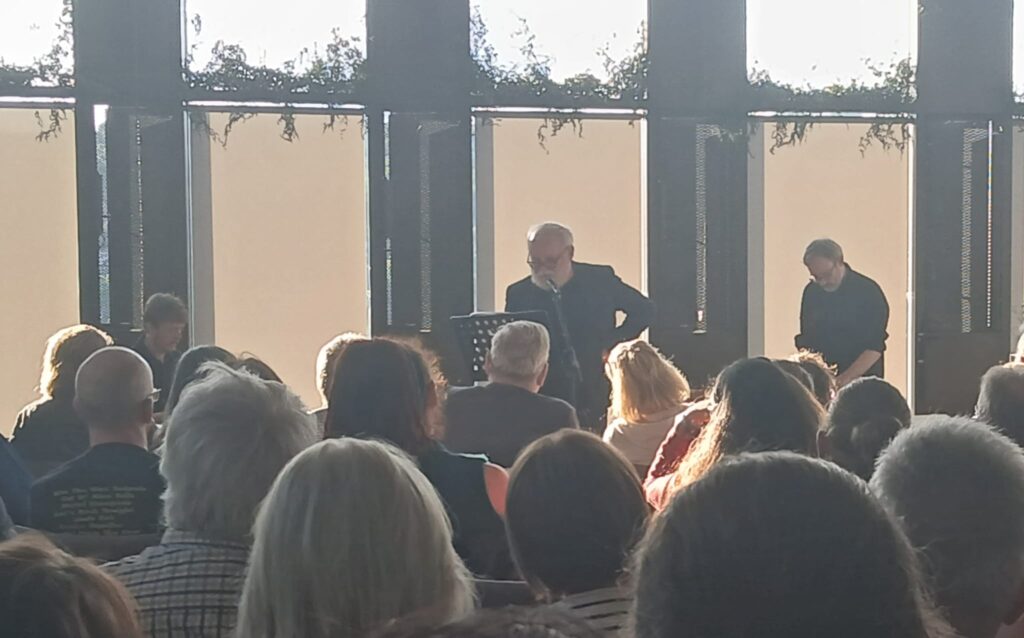
This time I was in Cork for a production in The Hub, in UCC. A literary/musical production by Pat McCabe, steel guitarist David Murphy and writer Michael Lightborne. It was a mellow, mixed media evening with Pink Floyd melodies, Bridie Gallagher, Patrick Kavanagh floating in and out of the stream-of-contrariness narrative. McCabe’s multi-voiced storytelling woven together with steel guitar against a multi-layered sound canvas. It all sat well in the mellow Cork air.
The sort of intimacy you see on Cork city streets is more reminiscent of a large town than the serious city Cork is. I can easily see how the Polish worker I met a while ago in Poznan found a second home in Cork. When I compare Cork city’s population now and Dublin’s in, say, the early 1900’s, the similarity in size probably goes a long way towards explaining the up-close-and-personal world of Bloom and his homies. There is an unspoken cultural independence to Cork though. It isn’t beholden to Dublin – or anywhere else, for that matter – or to international tourists. It’s not showy but well maintained and upbeat with colourful shops and well turned-out streets. And the river really is the thing, much more so than in Dublin.
Dublin is divided by the Liffey; Cork is united by the Lee.
I am never quite sure which side of the two I am on and I’m all the happier for that. Knowing where you are all the time and knowing the time all the time is one of the curses of the interweb age. A little Heisenberg Uncertainty is very therapeutic, every now and then. I don’t always need to know my position and momentum at the same time. And one of the easiest ways to disconnect from the all-knowing interweb is with a good book in the corner of a pub or café.
There was a Rory Gallagher exhibition in the central library (his personal collection of LPs – by their LPs shall ye know them) and I picked up a little charm of a book by a Prague writer by the wonderful Pushkin Press. A series of miniatures, slightly longer than short stories. On the train back home, I remembered I had an appointment in the PM in Dublin and carried on up the line.
As soon as I walked out of Heuston Station, a few hours later, I had ‘my smarts about me’, as an old New York friend once advised for NYC. Or, certainly, more smarts than you seem to need just strolling around the sister city to the south.