(https://www.focusfeatures.com/hamnet)
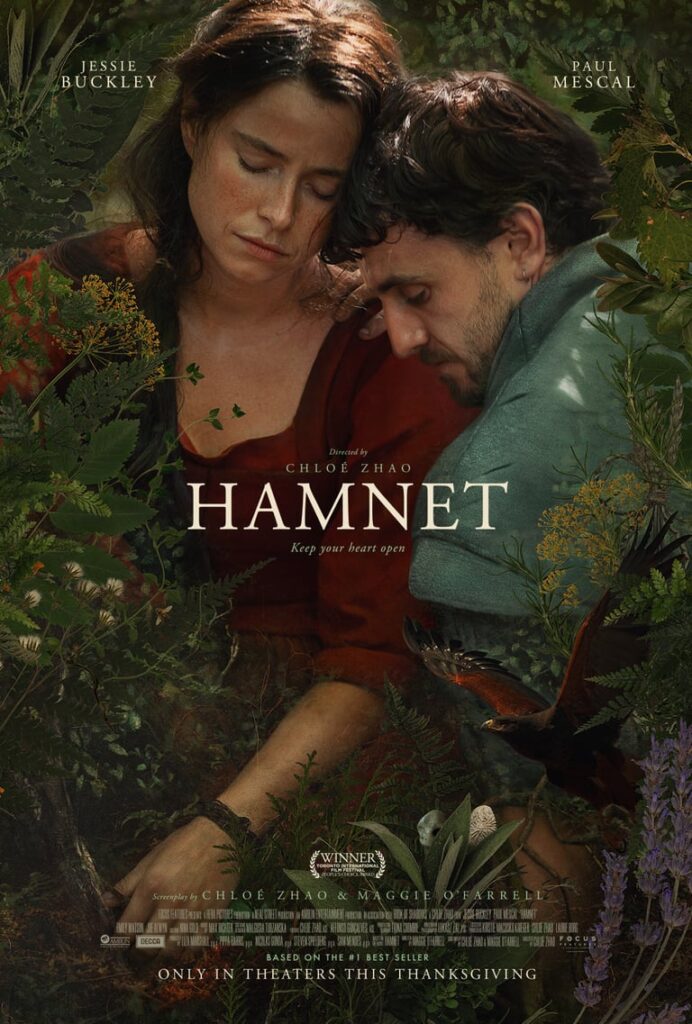
I wasn’t much surprised that Jessie Buckley won her Oscar. She deserved it. If some insisted that her performance in Hamnet was overwrought (overwrit?), that was surely what it was meant to be. A mother losing a young child – hardly an occasion for being underwrought and rational. I came upon Jessie Buckley first, in Tom Hardy’s magnificently overwrought series, Taboo. The moment she strode casually onto the tv screen to introduce herself as the ‘hidden’ wife with the killer line
‘What I’m owed isn’t in that pile of coins…’ I had a sense that she was here to stay.
Recently, I realised that I had known, if distantly, her great grandfather, when I was a child. Dr Comer was one of the ‘greats’ of my small Irish town in those days – among parish priest, garda sergeant and bank manager. Figures neither to be confronted nor ignored either.
Dr Jack Comer, was a veteran of the Irish Civil War, as was his wife, Jessie Buckley’s Great Grandmother, Madge Clifford. They were both what might be called Civil War Republican Elite. Old Dr Comer suffered for his allegiance during the Civil War, in terms of being turned down for state employment. His wife remained a staunch Republican. I remember nothing of her but I do remember him. He had the harrumphing, grumpy demeanour of a lot of older men of that era, who always seemed to resent being interrupted in their meditations.
He once visited me upstairs in my own grandmother’s house (doctors did house calls in those days). I was up in the small bedroom, in fever. I recall the heavy tread on the stairs and my grandmother standing back in the shadows as he examined me. And the big medical case he carried which, I assumed, could cure all ills. And the little cardboard pill box left on the bedside table after his diagnosis.
My mother, twenty years earlier, had a different sort of encounter with him. And if old Dr Comer was curmudgeonly and cantankerous, he met his match in my mother, only in her twenties, at that time, but as sassy as the character Jessie Buckley portrayed in Taboo. My mother had recently returned from working in London, in the last year of the war (The V2 bombings year). After contracting TB, and a lung collapsed as therapy, in a sanitorium in Surrey, she survived what many of her school pals back in the town didn’t, years before. Back home in my grandmother’s house to recuperate, she had to visit Dr Comer. The doc was less than welcoming being accustomed to deference, like the parish priest and the garda sergeant and the bank manager.
‘So, you came home to Ireland to be cured, did you?’
My mother snorted at him. ‘It was the English who cured me. I came home to stay with my mother.’
She loved to retell the tale. It had in it the germ of resistance to the idea that those who had emigrated and returned were somehow less than pure. And she wasn’t having any of that nonsense. And if she had to get a bit overwrought to get the point across, then that’s what she had to do.